Project "Chinatown"
"Miniature & Iteration"
Designed and Made by Kevin, Karl & Eric
Our group began our research in a broad area of Manhattan’s Chinatown, but as we scoped further we decided on a specific part of an underpass in that Chinatown under the Manhattan Bridge.
Our big question was just to make the bridge feel more inviting and more aesthetic, and our solution to this was to make the bridge look bigger with mirrors on two sides.
So we first decided on a lofi prototype, which was to create a model of the street and see how it looked.

The exact spot on Google Maps

Our Prepared Materials for the miniature
The reason why we decided on making a lofi prototype that was a replica of the underpass with cardboard and tiny mirrors was that our group wanted to ensure that our project would at least accomplish our primary goal: making the space look bigger.
Our primary stakeholders in this situation were the vendors that sold produce and seafood in the area as well as passersby, tourists, and customers. Our theory at first was that if we made the space more inviting, we would actually promote the business of the vendors there as it would be a unique place to buy produce from and could attract new customers which would then affect the vendor’s families as well when their profits increase. Passersby and customers could enjoy the more aesthetic area while also purchasing ingredients to prepare meals for their family and friends back home.
The aspects we included in our miniature

To effectively gauge how correct our theory was, we attempted to do a few interviews at the location; however, to our disappointment, our interviews were turned down by the vendors and locals there.
While it was a little disheartening to be turned down so quickly, we didn’t let that minor setback get to our heads and actually revisited the location a few days later. This time, we were more aware and understanding of the opposite side and per their wishes we only recorded their words (by writing them down) instead of recording through voice or video.
First, we asked a vegetable vendor about how he felt selling where he was and whether there were any improvements he’d like to have. His response was that this underpass is actually a good place to make money selling products as there are many locals and people passing by that purchase his produce, though he did wish there was air conditioning during summer times. (Though that wouldn’t work because it’s an outside venue and air conditioners work by pumping hot air out, not cold air in)
Next, we asked a young lady passing by what she thought about the area and any improvements she would recommend. Her response was that this area felt crowded and stressful, and while it wasn’t too crowded to walk through, it still felt uncomfortably narrow.
Finally, we talked to an old man who revealed himself to be a long-time local that lived not far from our area. He told us he has been a customer to this area for a long time and his thoughts were that he wished the area to look a bit prettier, “I wish sometime in the future this market could become a better place for more people to come. Despite its really cheap prices, it still has a long way to go to improve its atmosphere.”
From these interviews, our group was now confident that we were in the right direction with our solution. The mirrors would not only make the place feel a little bigger, but it would also improve the aesthetic and become more inviting to the vendors and customers that go there every day.
Confident in our solution, our next step was to create a lofi prototype to test out our design and plan our arrangement of mirrors.
Taking everything above into account, we set to creating a small cardboard replica of the area for an easier way to place our mirrors around and see how our solution would look before we executed it in a larger scale.


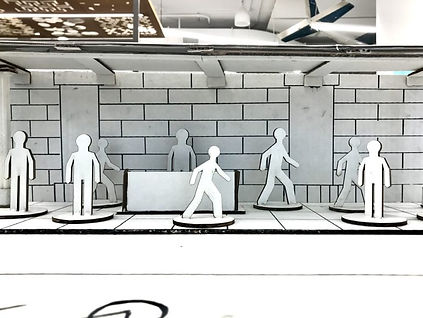
P1. Wall of the bridge
P2. With the sidewalk and lane
P3. Passers-by of different ages and heights
P4. With under part of the bridge and the vendor
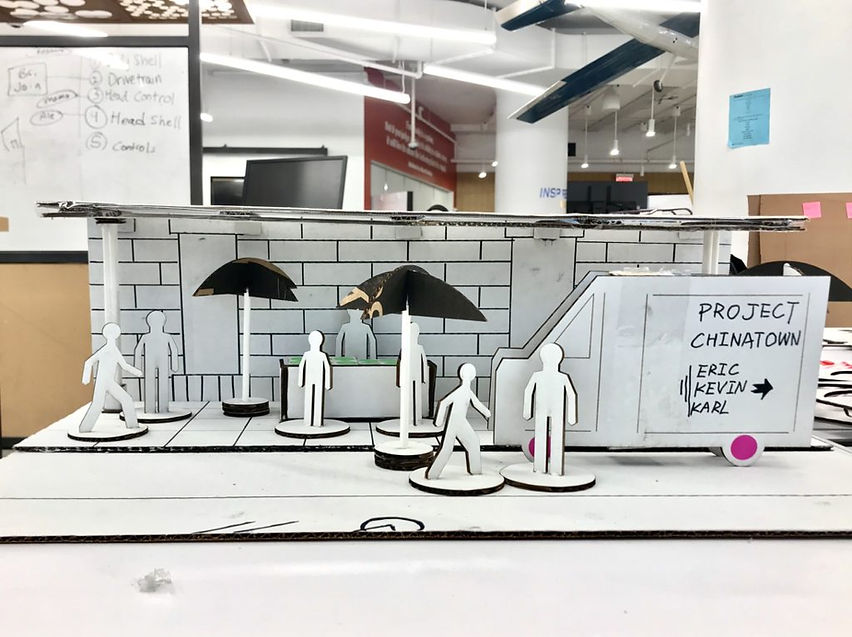
After our replica was complete, we really experimented around with the mirror placement to see which way would look more pleasing to the eye. But we also began researching the solutions of other people in the world.

We first came across this idea, which was to put these cool colored LEDs on the underside of a bridge, which was done in Philadelphia on 21st street under JFK Boulevard. While the idea looked great, there were a few reasons why we did not consider this: First, electricity would be hard to connect and utilize to set up these LEDs, and while we could use battery-powered LEDs, we would run into the second reason: The reason why most street lights you see are yellow is because blue light disrupts the day-night cycle pattern of many creatures that live in the cities (squirrels, bugs, birds, etc.) and since any color besides red and yellow contain blue light in them, and red is more of a reserved color for stopping and emergencies, there would be no point in putting up any cool colors that change the aesthetic.
Furthermore, this idea would only work at night, whereas our mirrors are 24/7 no batteries included.

Of course, our research didn’t stop there. We also looked into painting a mural like the one in Warden Underpass in Ontario, Canada. However, our professor cautioned us that the Manhattan Bridge was a security site and directly modifying the look of the bridge may be illegal without city council approval. So that was out the window.
After digging through solution after solution, it just seemed like other improvements to underpass aesthetic was just different painting and LEDs we decided that our mirror was the most accessible and unique solution for our specific location and case. We set to work.
"Prototype 1"


Our first prototype was able to visually expand the room of the area and it would also reflect more light into the space during the day. It would be easy to install, but it would also look a little out of place. It also did not seem to be an optimal place to put them as it may get in the way of the vendors. Seeing this we decided to try another approach.
"Prototype 2"
Our second prototype built on the first one and we put mirrors on the ceiling of the underpass to see how that would look.

However, it would much very difficult, dangerous, or even illegal to implement. So we start to make the third prototype in order to find a better solution.

It looked a lot better, would reflect more light, and there’s an overall improvement to the atmosphere;

"Prototype 3"


It really seems like third time’s a charm because we hit an idea that we all liked on prototype #3. By laying 45-degree mirrors across both sides of the walkway, we create an easy-to-implement, aesthetically pleasing, and effective way to implement our mirrors. It looks great and doesn’t really get in anyone’s way.
"Final Draft"


In this final design, we incorporated ideas that we liked best from all the prototypes and added a bit of extra design that is influenced by traditional Chinese culture. While this may not be the exact final design that we implement, we have tackled many of the issues that we began the project with and are now ready to finally put our design out into the real world. In this design, we repositioned the mirrors to give more space on the sidewalk as well as add two more mirrors on opposite ends of the venue. Our final product will look similar to this but adapted to the actual location of our project.